Showing posts with label TechBits. Show all posts

Monday, December 5, 2011

Tech the Halls: 12 Christmas Decorations for Geeks [PICS]


1. Pantone Christmas Baubles

Color-code your Christmas with these stunning Pantone baubles.

Cost: $14 each or $62 for a set of five

Click here to view this gallery.

Here at Mashable we love the holiday season. Decorating your home, cubicle and heck — even your car — is all part of the fun.

However, traditional decs just aren’t geeky enough for our tech-loving tastes. To this end we’ve scoured the web for festive ornaments with a geeky or social media twist.

From Angry Birds to LEGO via Santa-Bots, we think you’ll like our 10 cool Yule creations. For more Dev & Design coverage:


Tech the Halls: 12 Christmas Decorations for Geeks [PICS]
Amy-Mae Elliott
Sun, 04 Dec 2011 19:37:40 GMT

Dell halts online sales of Streak 7 tablet, turns toward a new mobile future


You might wanna pause for a moment of silence, because it looks like Dell has just discontinued its Streak 7 tablet. As the folks over at Streak Smart recently noticed, the Android slate has mysteriously disappeared from Dell's website, replaced only with a note to confirm that it's no longer available online. Dell, which axed the smaller Streak 5 back in August, provided us with the following statement:

Dell remains committed to the mobility market and continues to sell products here and in other parts of the world. Streak 7 delivered a unique experience for customers who wanted a larger screen-size yet the freedom of staying connected to their personal and professional content while on the-go. It continues to be available in many markets through retail, distributors and carrier partners such as Optus in Australia. A 10-inch version of the tablet, Streak 10 Pro, is currently offered in China, offering the ultimate digital divide between work and life. The Venue and Venue Pro devices, as well, continue to earn accolades for performance, design and functionality around the world. We also recently launched the Latitude ST, a 10-inch Windows 7-based touch-screen tablet designed for vertical markets such as education, finance and healthcare in November of this year. We remain committed to expanding our reach beyond PCs with a targeted set of open, standards-based mobility solutions and services designed for commercial and mobile professional customers.

So Dell isn't leaving the mobile space entirely, and it doesn't look like the Streak 7 is completely dead, though based on the above statement, it certainly seems to be on its way to pasture.

Dell halts online sales of Streak 7 tablet, turns toward a new mobile future originally appeared on Engadget on Mon, 05 Dec 2011 07:32:00 EDT. Please see our terms for use of feeds.

Permalink Streak Smart  |  sourceDell  | Email this | Comments

Dell halts online sales of Streak 7 tablet, turns toward a new mobile future
Amar Toor
Mon, 05 Dec 2011 11:32:00 GMT

Windows 8′s Answer to the Mac App Store Comes Into Focus Tuesday


After years of leaving it to Windows software makers to sell their own wares, Microsoft’s flagship operating system is finalizing its plans to get into the app store business.

The move won’t come until the debut of Windows 8 — expected next year — but Redmond will share more details on Tuesday at an event in San Francisco.

Microsoft revealed that Windows 8 would have a built-in software marketplace back when it first showed the revamped interface at our D9 show in June, though at that point the company wouldn’t comment on the “Store” icon that was clearly visible in the home screen it showed. Microsoft did offer a few more details at its Build developer conference in September.

I’m sure we’ll learn a lot more on Tuesday (and naturally, AllThingsD will be on hand to get the full skinny) but here’s what we already know.

As of earlier this fall, the plan was that the store will be the exclusive way for developers to distribute new-style Windows 8 apps. Microsoft didn’t share the business details at its developer conference, though some documents made reference to some sort of revenue-sharing arrangement. The store will support free and paid apps, as well as trial versions and in-app payments. Businesses will also be able to make available internal apps to their workers using the store mechanism.

Traditional Windows apps will continue to be sold in the same way they have been — directly from developers and through online and brick and mortar stores. The store won’t be a way for users to directly purchase older-style Windows apps (the ones that run on Windows 7 and earlier versions in addition to Windows 8), but developers of those apps can create a landing page for those apps so they can be found in and linked to from the store.
The Windows Store itself is a new-style Windows 8 app that is linked to from the main start page.

Thanks to the iPhone, app stores are all the rage these days. Google has one for Android and Apple has transferred the concept to the Mac, with the marketplace it built into Lion.

Even though it is basically just following the trend, putting an app store in Windows is a big bet for Microsoft. Windows remains the company’s most important product and a key source of its revenue and profit. Inserting itself into the software distribution process opens up a potentially huge new income stream for Redmond, but also risks alienating developers — many of whom are trying to figure out just how much attention to give Windows these days, especially since new-style Windows apps use a different set of programming languages than those Microsoft has traditionally employed.

While Windows is one of the last to the app store game, Microsoft has considerable experience in this realm, already running online app stores for the Xbox and Windows Phone.

Among the key details to watch for on Tuesday will be what Microsoft’s business terms for software developers including the cut it hopes to take and other policies.

It will also be interesting to see if Microsoft has more to say about when it might release a beta version of the software. It handed out an early developer preview at the Build conference, though that edition had none of the code for the store. Developers will clearly need to start kicking the tires on the store fairly soon if Microsoft wants to have its virtual shelves stocked at launch.

Windows 8′s Answer to the Mac App Store Comes Into Focus Tuesday
Ina Fried
Mon, 05 Dec 2011 12:00:58 GMT

PortableApps.com Platform 'Next' Pre-Release 5 Released: Automatic Updates, Folders, App Store, Search, Portable Fonts, Theming and More!


PortableApps.com is proud to announce the latest release of our Platform (codename: Leo). Pre-Release 5 of the 'Next' platform, which become the stable version 10 of the PortableApps.com Platform this week, is available for immediate download. This 'Next' release has automated and customizable folders (aka categories) in the menu, our new theming engine with multiple chrome styles, the Portable App Directory app store for automatic download and installation of portable apps, find-as-you-type search to easily find apps in your ever-growing collection, an improved updater with better support for proxies, an improved options selection window, more-complete translations into more languages and lots more. Pre-Release 5 adds fixes for portable fonts, unicode sorting, improved localizations, multiple bug fixes, and now automatically checks for updates on startup by default. We're doing a lightning round of bug-fixes, feature additions and localization improvements over the next 24 hours, so we can use your help! This is also the final call to sponsor the PortableApps.com Platform for this release, so you can be part of the action. Read on for all the details...(permalink)

Existing 2.0/Next users can automatically update by clicking Manage Apps - Check for Updates

read more

PortableApps.com Platform 'Next' Pre-Release 5 Released: Automatic Updates, Folders, App Store, Search, Portable Fonts, Theming and More!
John T. Haller
Mon, 05 Dec 2011 06:34:06 GMT

Saturday, December 3, 2011

Verizon Gobbles Up $3.6 Billion Worth of Spectrum From Comcast, Others


In a $3.6 billion deal, Verizon Wireless just bought a large chunk of wireless spectrum from Comcast, Time Warner Cable and Bright House Networks. As spectrum sales go, it’s rather large — just a billion less than the record-setting $4.74 billion Verizon paid for part of the former UHF band in 2008.

The 122 licenses that Verizon’s picked up potentially reach about 80% of the U.S. population, or 259 million people. Comcast and the others, under the joint venture SpectrumCo, originally picked up the spectrum in a 2006 government auction for $2.37 billion.

The terms of the sale go beyond just a simple exchange, however. According to the press release, the cable companies and Verizon will effectively become agents for each others services. Comcast et al. will eventually have the option of selling Verizon service on a “wholesale basis.” The companies also are partnering to develop technologies that better integrate wireless and wireline services.

While the agreement has potential to create many new product innovations, the implications may conflict with some fundamentals of Net Neutrality, which generally holds that services should should not be given preferred status over an Internet connection, regardless of who’s providing that connection. In the Federal Communication Commission’s recently published rules on Net Neutrality, however, some exceptions are made for wireless services.

In the release, Neil Smit, president of Comcast, says the agreements will enable the company to focus on providing mobility for the company’s Xfinity services. Verizon Wireless CEO Dan Mead said the new spectrum will enable the company to improve its rapidly growing 4G LTE network.

The spectrum is exclusively in the Advanced Wireless Services (AWS) band, which involves microwave frequencies from 1,710 to 1,755 MHz as well as 2,110 to 2,155 MHz. The band is intended for data use on mobile devices. Back in 2006, the FCC auctioned of big parts of the AWS band to various wireless companies (most notably T-Mobile) as well as SpectrumCo, a joint venture between Comcast, Time Warner Cable, Cox, Sprint, and Bright House.

Cox and Sprint have since exited the partnership. Comcast is the big fish in that pond, owning 63.6% of SpectrumCo, netting it $2.3 billion on today’s sale. Time Warner’s and Bright House’s slices amount to $1.1 billion and $189 million, respectively.

The deal is subject to approval by the FCC and review under the Hart-Scott Rodino Act, which deals with antitrust law.

Verizon Gobbles Up $3.6 Billion Worth of Spectrum From Comcast, Others
Peter Pachal
Fri, 02 Dec 2011 16:03:09 GMT

Friday, December 2, 2011

Android Beam in action: Ice Cream Sandwich's flashy NFC feature


NFC isn't just for mobile payments. Google uses it in its latest operating system to beam information like maps, videos, and contact information from one phone to another.

Android Beam in action: Ice Cream Sandwich's flashy NFC feature
Jessica Dolcourt
Fri, 02 Dec 2011 02:00:17 GMT

LG Nitro HD For AT&T: Hands-On


Nitro HD

Tonight at LG’s media event in New York City, we were lucky enough to get some quality time with the LG Nitro HD. The third in AT&T’s line of LTE-capable phones, the Nitro HD was announced earlier this week with a launch date of December 4 for AT&T. Some of its spec highlights include a 4.5-inch 720p display (like the HTC Rezound), a 1.5GHz dual-core processor, an 8-megapixel rear camera and 4G LTE support from AT&T, of course.

Since the Nitro was announced before its dedicated media event (and since it’s basically the Optimus LTE we’re seeing over in Europe), there’s really no reason to hash out all the specific deets. So let’s just get down to business, shall we?

First impressions:

  • Right off the bat the first thing you’ll notice is the Nitro’s size. It’s a hefty little beast with that 4.5-inch screen and a waist line of 10.4mm. That’s not terribly thick but not what I would call thin, either. For some perspective, it’s thickness falls right between the Droid Razr and the HTC Rezound.
  • The screen, as expected, is pretty slick running at 720p. With a resolution of 1280×720 on 4.5-inches of real estate, the LG Nitro HD actually has a slightly greater pixel density than the iPhone 4, at 329ppi as opposed to 326ppi. It’s not the best display I’ve ever seen, but it can certainly compete with many other recently released phones.
  • As far as performance is concerned, we have no complaints here. The NitroHD is snappy and super responsive, and web browsing was pretty enjoyable. We haven’t gotten a chance to test out AT&T’s LTE network as New York City isn’t quite on the list yet, so unfortunately reflections on that will have to wait.
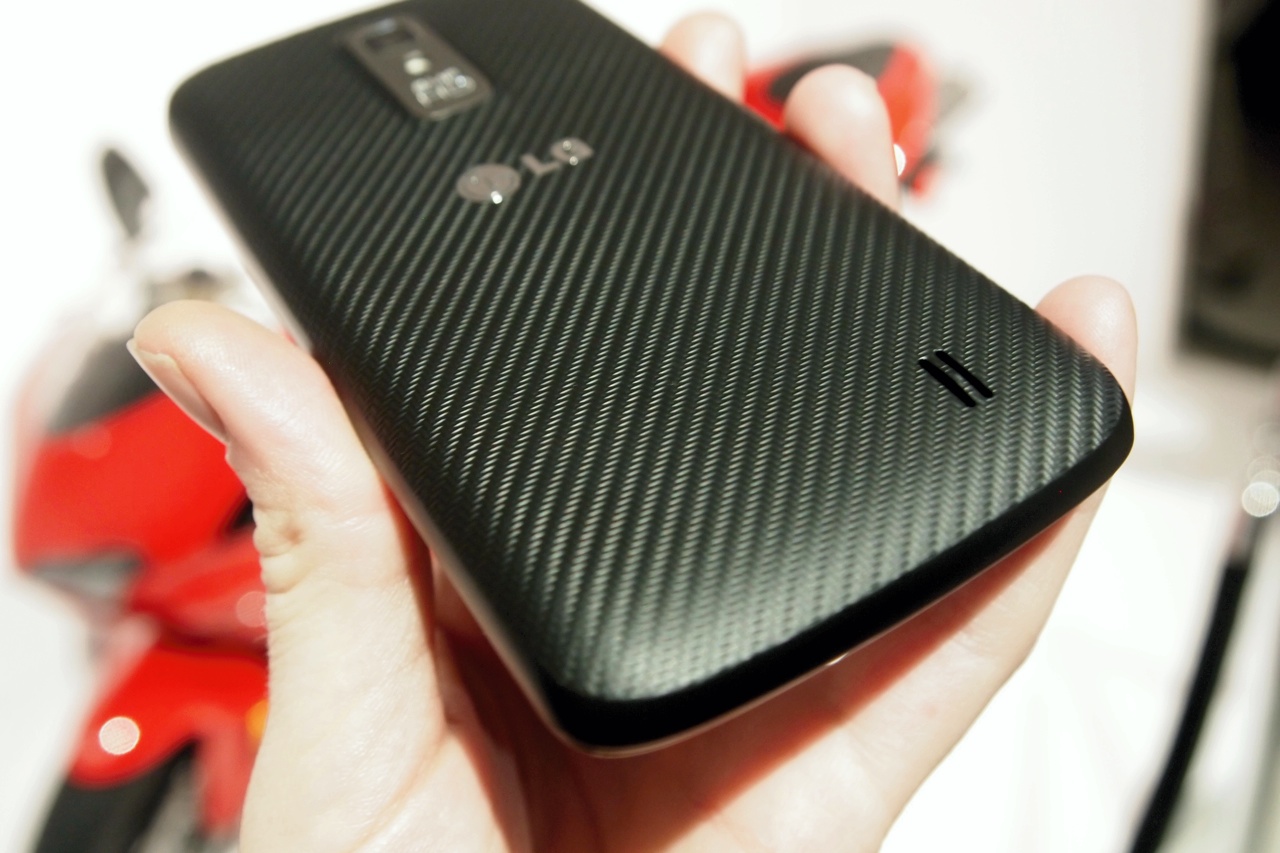
  • The textured back finish feels nice, and gives the Nitro a much pricier feel than its plastic casing would imply. Still, the strip of brushed plastic around the edge lets loose the secret that back panel was keeping.

  • The Nitro HD doesn’t take prints well at all, whether it’s the textured back panel or (most noticeably) the display.
  • The 8-megapixel rear-facing camera performed very well, handling white balance and movement between light and dark settings well. Shutter lag was a bit annoying, but it’s certainly no worse than most Android phones.
  • This particular LG device has an LG Optimus skin running over Android. It isn’t terribly obtrusive but does seem to slow things down a bit from a strictly vanilla experience.
  • I’m somewhat bothered by the fact that the charging port is square on the top of the phone, as that makes it pretty difficult to play around with in landscape mode while plugged in. It also has a plastic covering protecting the port, which will probably snap right off after a couple weeks of use.

All in all, I’d call the LG Nitro HD a fine option, but not necessarily my first pick. It packs specs that can compete on paper, but simply can’t keep up on the hardware front. The Nitro HD will show up on AT&T shelves December 4 for $249 with a two-year contract.


LG Nitro HD For AT&T: Hands-On
Jordan Crook
Fri, 02 Dec 2011 00:28:57 GMT

Verizon Samsung Fascinate receives Gingerbread


Verizon Fascinate GingerbreadIt took a long time for the Galaxy S phones in the US to receive Android 2.2 Froyo, so it’s no surprise that Gingerbread would take just as long as well. For those of you who own the Samsung Fascinate on Verizon, it looks like the day has come for you to finally get Gingerbread on your phones – provided you haven’t already done the job yourself by loading a custom ROM. We all know that Ice Cream Sandwich is already out, but since it’s not going to arrive on this phone anytime soon (unless Verizon/Samsung prove us wrong) and you don’t plan to get your hands dirty – you might as well just enjoy the official Gingerbread update first.

According to reports online, it looks like the update also fixes the phone’s GPS and signal strength issues. So if you own a Samsung Fascinate, keep an eye out for the update notification for your phone or try pulling it manually. As usual, back up your phone just in case, and do let us know how the Gingerbread update goes for you.

Verizon Samsung Fascinate receives Gingerbread, By Ubergizmo. Top Stories : Asus Transformer Prime Review,


Verizon Samsung Fascinate receives Gingerbread
George Wong
Thu, 01 Dec 2011 20:43:10 GMT

Roku Media Players - Products of the Week


If you are looking for a very affordable gift this holiday season that packs a lot entertainment punch, consider purchasing a Roku Box. The Roku is a compact media streamer that connects to the internet, via your internet router. Roku boxes offer either or both wired and wireless internet connection options. When connected to the internet, Roku boxes can stream a host of movies and TV content from services such as, Netflix, Amazon Instant Video, MLB TV, Hulu Plus, and more. However, one limitation is that unlike a network media player, the Roku box cannot access audio and video files stored on your PC, it does not access content stored on your PC or MAC, or portable USB devices.

For additional suggestions, check out my list of Best Network Media Players and Media Streamers.

Follow Me On Twitter and Facebook

Roku Media Players - Products of the Week originally appeared on About.com Home Theater on Friday, December 2nd, 2011 at 10:00:52.

Permalink

Roku Media Players - Products of the Week
Fri, 02 Dec 2011 10:00:52 GMT

Google, Microsoft, Yahoo, ISPs, All Served With Streaming Site Blocking Demand


A trio of organizations representing the movie, cinema and TV industries have gone to court in France in an attempt to force Google, Microsoft, Yahoo and the country's ISPs to block several streaming sites. The groups, which represent hundreds of video-related companies such as Paramount and Sony, want streaming sites blocked to Internet subscribers and delisted from search engines.


Google, Microsoft, Yahoo, ISPs, All Served With Streaming Site Blocking Demand
Thu, 01 Dec 2011 12:54:41 GMT

Official: Lenovo adopts Windows Phone


MS OS handsets out in 2012

Lenovo has confirmed rumours that it plans to enter the Windows Phone business, with handsets due in the latter half of next year.…

Official: Lenovo adopts Windows Phone
Thu, 01 Dec 2011 11:40:13 GMT

Thursday, December 1, 2011

Hewlett-Packard to Decide webOS Fate by Mid-December


Hewlett-Packard's new woman in charge, Meg Whitman, told a French newspaper that it's no easy task deciding what to do with HP's webOS division, but that a decision would be made one way or the other within the next two weeks. Part of what makes the decision so difficult is that there's a team of 600 people working with webOS at HP.

AllThingsD dug up the interview, which has been translated in full via Google Translate here. Whitman touched on a number of topics, including what prompted HP to reverse course and keep its PC business. According to Whitman, it would have cost HP $1 billion to sever its PC arm. On top of that, "the impact on our revenues would have been too high." And finally, Whitman said "the HP brand is indisputably linked to our PC."

Back to the topic of webOS and tablets, Whitman promises to a return to the tablet market with a Windows 8 slate in 2012. She also said that tablets are not yet comparable to PCs primarily because tablets are "mainly used to consume media and emails," and are poor substitutes for productivity chores.

Hewlett-Packard to Decide webOS Fate by Mid-December
Paul Lilly
Wed, 30 Nov 2011 16:50:06 GMT

Wednesday, November 30, 2011

Kindle Fire Auto-Update Scorches Roots and Potentially Shutters Android Marketplace [Amazon]


Click here to read Kindle Fire Auto-Update Scorches Roots and Potentially Shutters Android Marketplace

Amazon rolled out its newest software update for the Kindle Fire—version 6.2—this evening. Initial reports indicate that it both de-roots your jailbroken device and removes access to the Android Marketplace. But don't worry—the borking is reversible. More »

Kindle Fire Auto-Update Scorches Roots and Potentially Shutters Android Marketplace [Amazon]
Andrew Tarantola & Chris Beidelman
Wed, 30 Nov 2011 08:34:45 GMT

RIM to offer its mobile device management software on Andriod, iOS


Research In Motion's executives have apparently decided that if they can't beat Apple and Google, they'll join them. The company announced today that it will offer its mobile device management and security software for iOS and Android devices, allowing enterprise customers to manage them alongside BlackBerry phones.

The new software, BlackBerry Mobile Fusion, will provide many of the same central administration features now offered on RIM's own phone OS—including remote locking of devices and remote erasing of their storage, application and software management, security policy enforcement, and management of WiFi and VPN connections among them. The software will be available in the first quarter of 2012, according to a company statement.

The move is an acknowledgement of the growing trend of companies adopting "bring your own device" policies to accommodate employees' desire to use their own smartphones and tablet devices in the enterprise, and of the iPad's dominance in the tablet space.

By integrating with iOS and Android, RIM vice president of enterprise product management Alan Panezic told Reuters, RIM is shooting to "become the de facto platform" for managing mobile devices in the enterprise. "We will take full advantage of whatever security capabilities are provided by the core operating system—we're not going to hold back in any way, shape or form."

The problem RIM faces is that the mobile device management market is already crowded. The BlackBerry still remains a favorite of large companies and the government (though that favor may have diminished after the worldwide RIM e-mail outage in October), and that's largely been because of the platform's management features. It's possible that Mobile Fusion could give BlackBerry the opportunity to hang on to its mobile device management customer base (which the company claims includes 90 percent of the Fortune 500), or at least delay their decisions to move to multiple platform mobile device management tools from companies such as Good Technology (which is making inroads with RIM's government customers) and MobileIron. On the other hand, it could shoot RIM's handset business in the foot, as large companies dump the BlackBerry en masse and move to iOS and Android.

Read the comments on this post


RIM to offer its mobile device management software on Andriod, iOS
sean.gallagher@arstechnica.com (Sean Gallagher)
Tue, 29 Nov 2011 15:28:00 GMT

Verizon FiOS Customers Can Now Sign Up For New Xbox 360 Service, Will Let You Control Live TV With Your Hands


FiOS TV - Xbox Program Guide

Last month, Verizon and Microsoft announced a partnership that will bring live HD TV channels to Xbox 360 customers who have active Xbox Live Gold subscriptions. Through the agreement, customers who sign up for the service will be able to watch live TV via their Xbox, without having to purchase any additional hardware. Of course, the coolest part of the news was not that you could watch live TV on your…well, you know…your TV, but that you could control it via the Xbox 360 Kinect. Yep, prepare to channel surf with your hands and your voice!

The offer is now ready to order, says Verizon, which has just launched the sign-up form here for new FiOS customers. Existing customers can just call Verizon to add an Xbox to their current service. (Note that in addition to Xbox Live Gold, you’ll also need to subscribe to both FiOS TV and FiOS Internet in order for this service to work).

To encourage new sign-ups, Verizon is offering an $89.99 “triple-play” package with TV, 35/35 Mbps Internet and Verizon voice service. They’ll even throw in a 12-month subscription to Xbox Live Gold and the “Xbox Halo: Combat Evolved Anniversary” game. The offer is good through January 21st.

OK, now for the bad news: the sign-up form is live, but the service itself is not. Verizon says the FiOS TV app will not be available for download until next month. This is how you’ll be able to magically control the live TV channels using voice and gestures.

The live TV offering will launch with 26 channels on board, including MTV, Spike, Food Network, Comedy Central, HBO, CNN and Nickelodeon.

As a part of the deal, Verizon is also running a promotion with gaming network Machinima to sponsor the Gamers’ Choice Award for the Inside Gaming Awards. Voters can vote via Facebook or Twitter (using #FiOSGamers) for a chance to win two years of the trip-play service, a multi-room DVR, Microsoft Kinect and 40,000 Microsoft points.


Verizon FiOS Customers Can Now Sign Up For New Xbox 360 Service, Will Let You Control Live TV With Your Hands
Sarah Perez
Tue, 29 Nov 2011 16:12:08 GMT

Protocol deal to bring compatible Microsoft apps to iOS, Android


Microsoft said on Tuesday it will license the protocols for many of its enterprise systems to a company that will develop compatible applications for non-Microsoft mobile operating systems, including Google's Android and Apple's iOS. Agreeya Mobility will develop a suite of mobile applications that will be compatible with Microsoft products such as Remote Desktop Services, Windows Azure, Active Directory, and SharePoint.

Protocol deal to bring compatible Microsoft apps to iOS, Android
Tue, 29 Nov 2011 12:12:44 GMT

Silver Lake and Microsoft's Yahoo Bid


Private-equity firm Silver Lake has joined with Microsoft to try to acquire a minority stake in Yahoo, say persons familiar with the matter

Silver Lake and Microsoft's Yahoo Bid
Tue, 29 Nov 2011 03:43:46 GMT

Tuesday, November 29, 2011

Best Buy, Verizon, Dell launch Cyber Monday deals


HP Pavilion listed on Best Buy Cyber Week page goes for $349 and includes a Sandy Bridge-class Intel processor and 500GB HDD.

(Credit: Best Buy)

Best Buy, Amazon, Verizon, and Dell launched Cyber Monday deals featuring discounted laptops, tablets, and smartphones.

Best Buy is calling its sale "Cyber Week" and puts Lenovo, Hewlett-Packard, and Toshiba laptops at the top of the list on its launch page. All three come with Windows 7 Home Premium.

Best Buy laptops listed on Cyber Week page:

  • Lenovo, $299.99: Model: 1450ABU. 15.6-inch LED-backlit display, AMD dual-core E-450 accelerated processor, 4GB memory, 320GB hard disk drive, and optical drive.
  • HP Pavilion, $349.99: Model: g4-1229dx. 14-inch LED-backlit display, Intel dual-core "Sandy Bridge" Pentium B950 processor, 4GB memory, 500GB hard drive, and optical drive.
  • Toshiba - Satellite Laptop, $379.99: Model: C655-S5305. 15.6" LED-backlit display, Intel Sandy Bridge Core i3-2330M processor (2.2GHz), 4GB memory, 320GB hard drive, and optical drive.

Dell, for its part, is offering an Inspiron 14R laptop for $399, $100 off regular pricing. It includes a 14-inch HD (7... [Read more]
Related Links:
Holiday 2011 laptops for every budget
Will Kindle Fire kill the $500 tablet?
Black Friday online shopping leaps 26 percent
Black Friday deals you can get right now
Asus, Dell: We're not exiting the Android tablet business
 

Best Buy, Verizon, Dell launch Cyber Monday deals
Brooke Crothers
Mon, 28 Nov 2011 07:08:32 GMT

Sunday, November 27, 2011

Microsoft acquires VideoSurf to make Kinect do what Google TV can't


Microsoft announced on Tuesday that it had acquired video search company VideoSurf, which in September launched its technology for identifying video content based upon images captured with a mobile phone camera. Microsoft says it will add this technology into the Xbox 360 ecosystem, improving the search and discovery of entertainment content on Xbox Live.

To bring live television to Xbox Live, Microsoft has partnered with more than 40 different content providers in over 20 countries, including television networks and multi-service operators. Microsoft on Tuesday said the acquisition of VideoSurf will help these companies integrate their content into Kinect voice search.

"VideoSurf's content analytics technology will enhance the search and discovery of entertainment content across our platform," said Alex Garden, director of Xbox LIVE for the Interactive Entertainment Business at Microsoft. "This holiday we will launch voice search across our entertainment partners on Xbox LIVE. Over time, as we integrate VideoSurf's technology into our system, we are excited about the potential to have content tagged in real time to increase the speed and relevance of the search results."

Microsoft first debuted Kinect Voice search at BUILD in September, which showed how Microsoft planned to add Bing-driven voice search to Xbox 360.

Like Google has attempted (and largely failed) to do with Google TV, Microsoft is attempting to add rich web-like search capabilities to television, but instead of utilizing a keyboard, remote control, or huge video game-like controller, it is harnessing the power of the natural user interface with Kinect.

Microsoft acquires VideoSurf to make Kinect do what Google TV can't
Tim Conneally
Tue, 22 Nov 2011 16:46:33 GMT

Samsung jumps into bed with Google TV


Telly service needs a lot of lovin' right now

South Korean electronics giant Samsung is next in line to jump into the sack with Google on its TV services, ignoring the lacklustre uptake.…

Samsung jumps into bed with Google TV
Tue, 22 Nov 2011 15:01:07 GMT